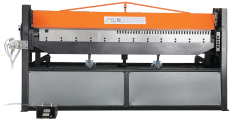
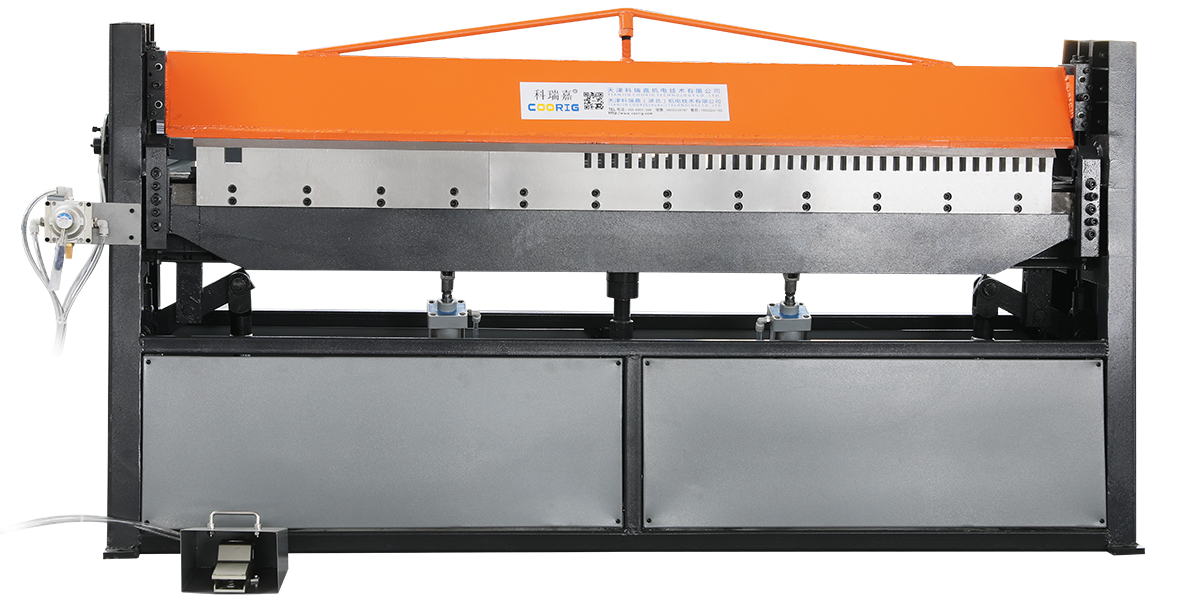
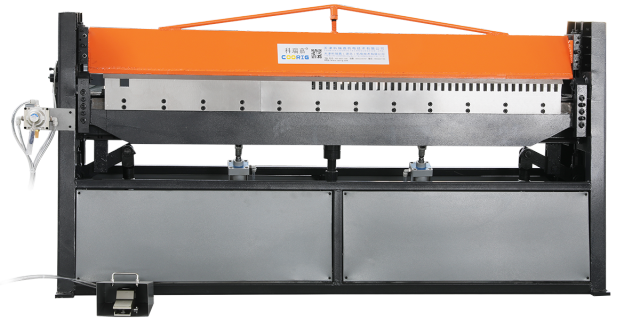
Rectangular duct fabrication means folding a lot of edges, and every one of them has to come out the same. This machine is built for that job: a pneumatic folding station that clamps the sheet and turns the edge over using compressed air instead of an electric drive.
That single design choice shapes how the machine is used. The clamp and the folding beam are both air-driven, so there is no motor to wire in and no power cable to route. The only service it needs is a shop air line at 0.6–0.8 MPa, which means it can stand in the bay where the work actually is rather than wherever the distribution board happens to be. Shops re-laying a fabrication floor, or working out of a second building without spare power capacity, tend to notice this first.
Day to day, the operator squares the blank against the lower beam, holds it, and starts the cycle with the foot pedal. The clamp closes, the folding beam completes the stroke, and the edge comes out on the same line every time the sheet is positioned the same way — which is the point. A hand-folded edge depends on how fresh the operator is at four in the afternoon; a powered stroke does not.
Automatic mode carries the cycle through without anyone leaning on a beam, so a shift's output is set by handling speed rather than arm strength. A pneumatic folding machine for HVAC ducts like this one is usually bought for exactly that reason: the same crew handles more duct, and fold quality stops drifting from operator to operator, which is where a lot of downstream assembly time quietly disappears.
Two working lengths are available, 1500 mm and 2050 mm, and both run on the same air pressure. Choose by the longest edge you fold in a normal week. Dimensions, weights and order codes are set out in the specifications section.
| Parameter | AF-1.5x1500TDF | AF-1.5x2050TDF |
|---|---|---|
| Order code | 3035 | 3036 |
| Working length | 1500 mm | 2050 mm |
| Drive | Pneumatic clamp and fold | Pneumatic clamp and fold |
| Air pressure | 0.6–0.8 MPa | 0.6–0.8 MPa |
| Power supply at machine | Not required | Not required |
| External dimensions (L × W × H) | 2000 × 1000 × 1400 mm | 2600 × 1000 × 1400 mm |
| Weight | 700 kg | 850 kg |
Both versions of this TDF folding machine are the same unit at two working lengths, so the decision is about the edges you fold, not about different technology.
The 1500 mm version is where most shops start. It takes blanks up to 1500 mm across the fold line, which covers the short sides of a wide range of rectangular sections without the machine dominating the bay, and the shorter frame repositions more easily when the shop layout changes.
The 2050 mm version adds working length for duct sides that would otherwise need two set-ups or a hand finish at the end. Shops that regularly fold the long sides of larger rectangular sections usually find the extra length pays for itself in handling time rather than in cycle speed — the stroke itself is the same.
Because length is the only difference, everything else carries over. Both run at 0.6–0.8 MPa from the same shop air line, so a shop running two machines sets one regulator pressure and forgets it. Both are operated identically, with the same foot pedal and the same automatic cycle, so an operator can move between them without retraining. Dimensions and weights for each length are listed in the specifications section.
If your duct range mixes short and long sides, think about where the time goes. Folding two short sides on the larger machine costs nothing. Folding one long side on the smaller machine means repositioning the blank mid-fold, and that is exactly where fold lines start to wander. As a pneumatic folding machine manufacturer we would rather see a shop buy the length it actually needs than save floor space and fight the work every day.
One figure settles it before ordering: the longest single fold in your normal production week. That number, more than the average duct size, decides between 1500 mm and 2050 mm.
Duct fabrication runs in a sequence: sheet is cut and notched, edges are formed, flanges are folded, then the section is assembled and sealed. This machine owns the folding step. In most shops it stands between the TDF roll former and the assembly bench, so a blank travels a few paces from forming to folding and the finished section is easy to move on.
It suits rectangular duct shops that fold TDF flanges through the day and want the same fold from every operator on every shift. It suits prefabrication shops that already have compressed air but limited spare power capacity, or that are re-laying the floor and do not want to run cable to a new folding bay. It suits growing shops adding a second folding point to keep pace with a duct line without an electrical upgrade, and MEP contractors running their own prefab shop where the machine starts and stops with the project schedule. Workshops where hand folding has become the bottleneck — or where fold quality swings with operator fatigue — are the classic case. So are shops that fold the long sides of large sections and lose time repositioning a short machine.
In a shop like that, a pneumatic folding machine for HVAC ducts earns its place because the cycle repeats. Two operators, two shifts, the same blank: the fold lands on the same line, and assembly stops compensating for variation.
It also changes how the bay is planned. With no power run to design around, the machine can move with the workflow — closer to the roll former during a run of large sections, closer to assembly when the shop is finishing. The trade-off is the air line, so settle the hose route and the regulator position before the machine lands.
Most of the maintenance on this machine is about the air supply and keeping the folding line clean. Start the day by draining the water trap or filter on the air line: moisture is the usual reason a pneumatic stroke turns lazy or judders, and it shows up as an inconsistent fold long before anything looks broken.
Wipe swarf and metal dust off the lower clamp and the folding beam before the first job. A chip trapped under the blank marks the sheet and pushes the fold line off by enough to be noticed at assembly, and that is rework nobody budgets for. Check the hose and fittings for chafing or leaks while you are there — a small leak costs pressure at the moment of the stroke, which is when you need it most.
Re-check the regulator after anyone works on the shop air line. A pressure drop does not announce itself; it appears as a fold that has started to drift, and the operator at the machine usually gets blamed first. Lubricate the moving points on the schedule set out in the machine manual, and keep the pedal area clear of offcuts and pallets so a stroke is never started by accident.
If a fold starts drifting while the pressure is correct, stop and look at the tooling edge and the blank rather than pressing the pedal harder. Forcing a stroke with the sheet out of position is the most common way to damage a folding beam, and it is the one fault a maintenance routine cannot prevent for you.
Tianjin Coorig Technology Co., Ltd. has been building sheet metal and MEP prefabrication equipment since 2004, with a team of around 200 people working from our own factory in Tianjin, China. In more than 20 years we have supplied buyers in over 35 countries — processing plants, mechanical installation contractors and agents — and we look after export, documentation and shipping as a one-stop service. A database of 3,000+ qualified suppliers, in-house quality control and our automated manufacturing systems keep build quality and delivery predictable. Reference work includes the Beijing Olympic Games, Egypt CBD, Guangzhou Baiyun Airport and BYD's European Center.
Not at the machine itself. A pneumatic folding machine for HVAC ducts runs on shop air at 0.6–0.8 MPa, with both the clamp and the folding beam driven by compressed air. You will still need a compressor with enough output to hold that pressure at the machine while it cycles, and a clean, dry line to feed it.
Judge it by the longest edge you fold in a normal week. If most of your work sits within 1500 mm across the fold line, the shorter machine fits a bay more easily and does the job. If you regularly fold the long sides of larger rectangular sections, the 2050 mm version removes a repositioning step and keeps the fold line continuous. Both take the same air pressure and are operated the same way.
Our published figures cover working length, air pressure, dimensions and weight. Send us the material and gauges you actually run, with a sample blank if you can, and we will confirm the version and setup against your work before you commit — that is far more reliable than guessing from a table.
Automatic mode carries the clamp and the fold through the full stroke on one press of the foot pedal. The operator lines the blank up and checks the result; the machine does the clamping and the folding, so the result does not depend on how much force someone applies by hand.
Yes, but plan the move. Both versions are heavy floor-standing machines on their own base, so shift them with proper lifting equipment over a level floor and allow for the air hose and pedal cable at the new position. Check door widths and floor loading on the route before the machine is delivered.
TDF flange folding for rectangular duct fabrication sits between the roll former and the assembly bench. This is a standalone folding station, so there is no line controller to wire into: blanks arrive from the roll former, are folded, and move on to assembly. If you are laying out a new bay, send us the sequence you plan and we will confirm the working length and how far the air line needs to reach.