
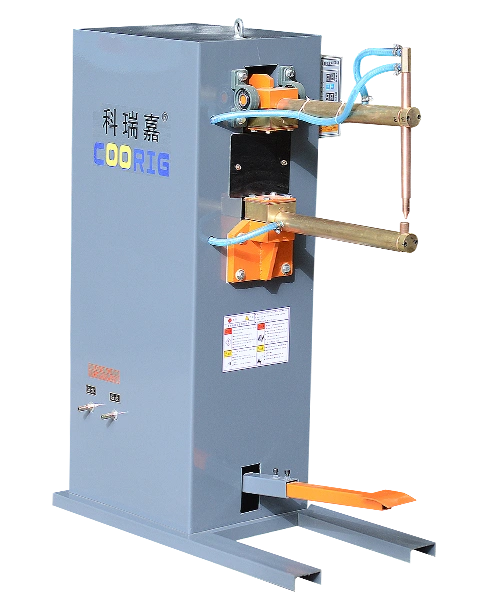
Pneumatic Spot Welding Machine
Discover COORIG's SDM-1602, the ultimate spiral duct machine for sale. Perfect for high-quality spiral duct work and manufacturing.
View productA plug-in flange line combines coil feeding, roll forming and cutting at 6 m/min under CNC control. This guide helps duct-shop owners and production managers compare configurations, confirm suitability and prepare a quotation brief for a TDC flange machine, with a consistent framework for evaluating any cnc tdc flange machine.
Five self-checks. Answer them before you read a single quotation — they decide whether the rest of this page is worth your time.
Fit ifyou form plug-in flange joints across a spread of duct dimensions and want one line to cover that spread instead of hand-fitting each size.
Look elsewhereif every joint you make is a single fixed size and the annual volume is small — a dedicated bench setup will be cheaper to run.
Fit ifflange forming runs for most of the shift and a stoppage queues work behind it.
Look elsewhereif flange joints are an occasional task between long stretches of other work.
Fit ifyour duct work sits inside one or two consistent gauge bands that can be written down and quoted against.
Look elsewhereif your order book swings between very light and very heavy gauges and no single profile setting covers the range.
Fit ifmanual or semi-automatic flange insertion is the bottleneck between the plasma table and the assembly bay.
Look elsewhereif your existing flange method already keeps pace with forming and welding upstream.
Fit ifyou cannot reliably staff flange forming, or the person who does it is your most experienced hand.
Look elsewhereif skilled labour is abundant and idle between jobs — the payback case weakens quickly.
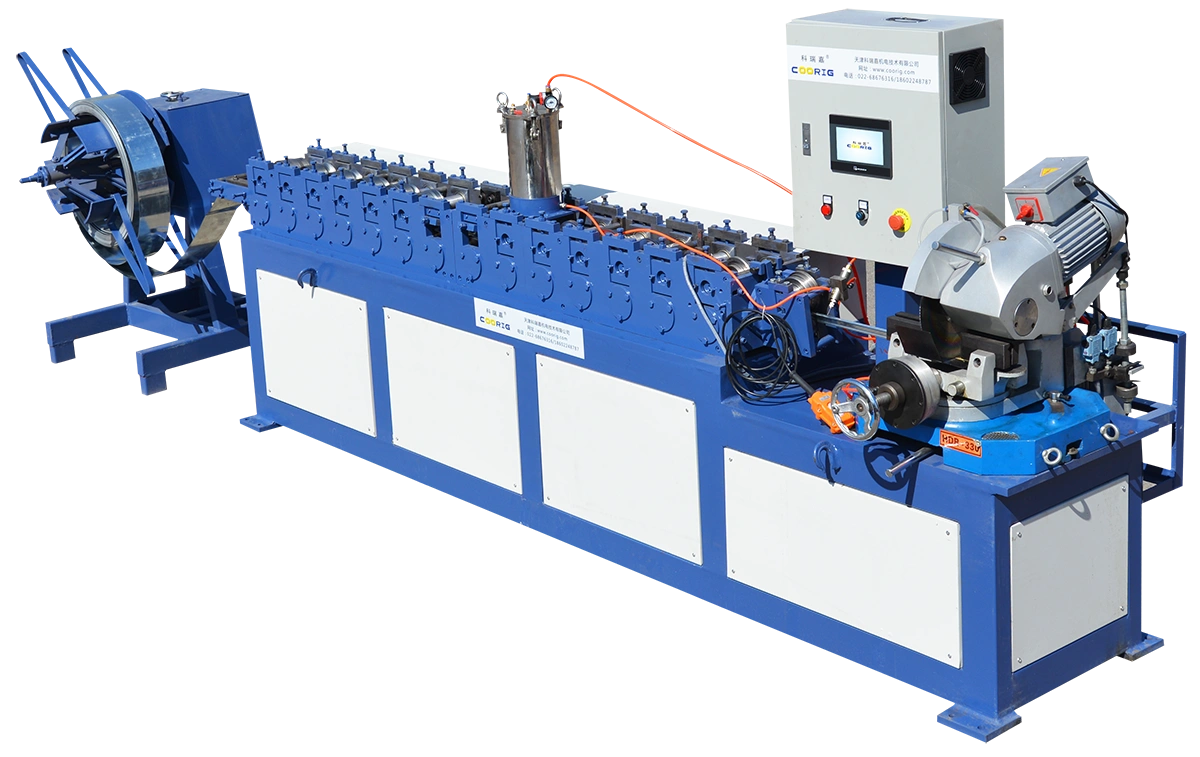
The published build sequence runs one way: coil in, profile formed, cut on the fly, parameters held by the control. Read each stage for the buyer decision it creates.

The strip supply that keeps the former running without a manual reload mid-batch. Buyer decision: confirm the coil width and coil weight your supplier must handle, and check that your local coil source can deliver in that format.
Where the plug-in flange profile is actually rolled into shape. Buyer decision: the profile is set by tooling, so ask which profile standard the rolls are cut for and request the corner-code parameter values in writing.
Cuts the formed flange joint without halting the forming sequence. Buyer decision: this is the stage that turns the 6 m/min figure into real output — ask how cut length is set and how offcuts are collected.
Holds the operating parameters so a repeat batch starts from a known setting rather than an operator's memory. Buyer decision: ask how many parameter sets can be stored, who trains the operators, and what support is available in your language and time zone.
Glue injection is an option on this line, not a different machine. Here is how to decide whether it belongs in your first order.
Choose this route when sealed flange seams are already a project requirement rather than a future ambition.
Choose this route when you want the flange line first and the sealing capability once sealed-seam work is confirmed.
Verdict: if sealed seams are on your current drawing set, order the module with the machine; if they are not, ask for the retrofit scope and cost to be stated in the original quotation so the door stays open without adding capital now.
Split the sheet in two: what the published specification already confirms, and what only a written quotation can settle.
| Parameter | Status | What it means for the purchase |
|---|---|---|
| Working speed | Confirmed · 6 m/min | Use this figure to build a takt-time estimate for your typical joint before you compare suppliers. |
| Control | Confirmed · CNC | Repeat batches start from stored parameters rather than operator judgement. |
| Line configuration | Confirmed | Feeding coil/rack, main rolling forming machine, non-stop cutting device and CNC system are the four listed sub-assemblies. |
| Cutting method | Confirmed | A non-stop cutting device is part of the build, cutting while forming continues. |
| Automatic glue injection | Confirmed · optional | An added module, not a base-machine feature — decide it before the order is signed. |
| Duct dimension & thickness range | Confirm at quotation | The page describes continuous processing across various duct dimensions and thicknesses; no numeric range is published, so require a written range covering your largest and smallest duct. |
| Coil width and coil weight | Confirm at quotation | Settles your strip sourcing and how often the line must be reloaded. |
| Corner code parameters | Confirm at quotation | Corner-code technical parameters are referenced on the product page but values are not published — get them in writing alongside your corner-code supply plan. |
| Power, air and floor space | Confirm at quotation | Request a layout drawing: this is the figure that proves the line fits your bay. |
| Lead time, packing, training, warranty | Confirm at quotation | Make each one a dated line in the offer, not a verbal promise. |
Pick the scenario closest to your shop. It tells you which part of the specification to interrogate first — and what to put in the quotation request.
| Your scenario | Specification it stresses | What to confirm at quotation |
|---|---|---|
| Narrow size range, high volume | Working speed and the non-stop cutting device | Ask for a takt-time calculation at 6 m/min for your most common joint, including the cut cycle, so output per shift is a number you can plan around. |
| Many duct sizes, frequent changeover | CNC system and parameter handling | Ask how many parameter sets can be stored and recalled, and how long a size change takes on the machine you are being quoted. |
| Projects that call for sealed flange seams | Optional automatic glue injection | Specify the module with the order and request sealant specification, consumption per joint and refill supply as quoted line items. |
| Adding the line to an existing automated duct line | Integrated feeding, forming and cutting sequence | Ask for interface details, a layout drawing and the power and air requirements needed to slot the line into your bay. |
| Floor space is tight | Base footprint versus the glue-injection variant | Request layout drawings for both configurations — the supplier states the glue module can be incorporated without compromising footprint. |
| Replacing a labour-dependent flange bench | Operator count and training scope | Ask how many operators the line needs, what training is included and what remote support is available after commissioning. |
Price is negotiated; the drivers behind it are not. These five items decide both the capital figure and the payback period — ask about each one by name.
A line running at 6 m/min with non-stop cutting changes the labour equation from one operator per bench to one operator per line. That gap is the core of the payback case.
Ask: operators required per shift, and output per shift at 6 m/min.
Corner codes are a running consumable, and roll tooling is set by profile. Both belong in the five-year cost, not just the purchase order.
Ask: corner-code parameters, sourcing, and spare roll availability.
Only relevant if the automatic glue-injection module is specified — but if it is, sealant consumption per joint is an ongoing line in your costing sheet.
Ask: sealant specification and consumption per metre of flange.
Site preparation, power connection, compressed air and ducting extraction can rival the deposit on a small installation. Get the numbers before you sign a lease extension.
Ask: layout drawing, connected load and air demand.
Slotting a CNC line into an existing duct line costs engineering hours, not machine hours. Commissioning and training scope drives the real start-up date.
Ask: commissioning duration, training days, and who pays travel.
A single line with no local spares is a single point of failure for the whole shop. Spare-part depth is a purchasing decision, not an afterthought.
Ask: recommended spares kit and typical response time.
Send the same ten questions to every supplier on your shortlist. The answers — and how quickly they arrive — are the shortlist.
Send your duct size range, material thickness, target output and whether you need the automatic glue injection module. You get a configuration answer back at 6 m/min against your own production figures — not a generic brochure sheet.
Keep adjacent product options together for a faster catalog comparison.
Discover COORIG's SDM-1602, the ultimate spiral duct machine for sale. Perfect for high-quality spiral duct work and manufacturing.
View product
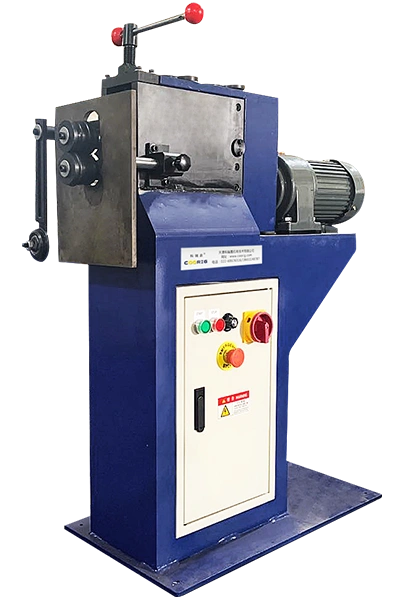
Mainly used for making pressure bars, connections, etc. for circular pipes. To roll thin plates into convex ribs of a certain shape, with the aim of strengthening the rigidity of sheet metal, pipes…
View productthe published working speed is 6 meters per minute. use that figure when you estimate output for your typical flange joint.
the listed configuration consists of a feeding coil/rack, a main rolling forming machine, a non-stop cutting device, and a cnc system.
operation is cnc-controlled. the cnc system is one of the four listed sub-assemblies and is part of the integrated feeding, forming, and cutting sequence.
automatic glue injection is an optional feature for seam sealing during flange formation. it is not listed as part of the base configuration.
the non-stop cutting device is included in the line to cut the formed flange joint while the forming sequence continues. it is one of the four listed sub-assemblies.
the product information states that the line supports continuous processing of flange joints on various duct dimensions and thicknesses, but it does not publish a numeric range. ask for a written range that covers your largest and smallest duct and your heaviest gauge.