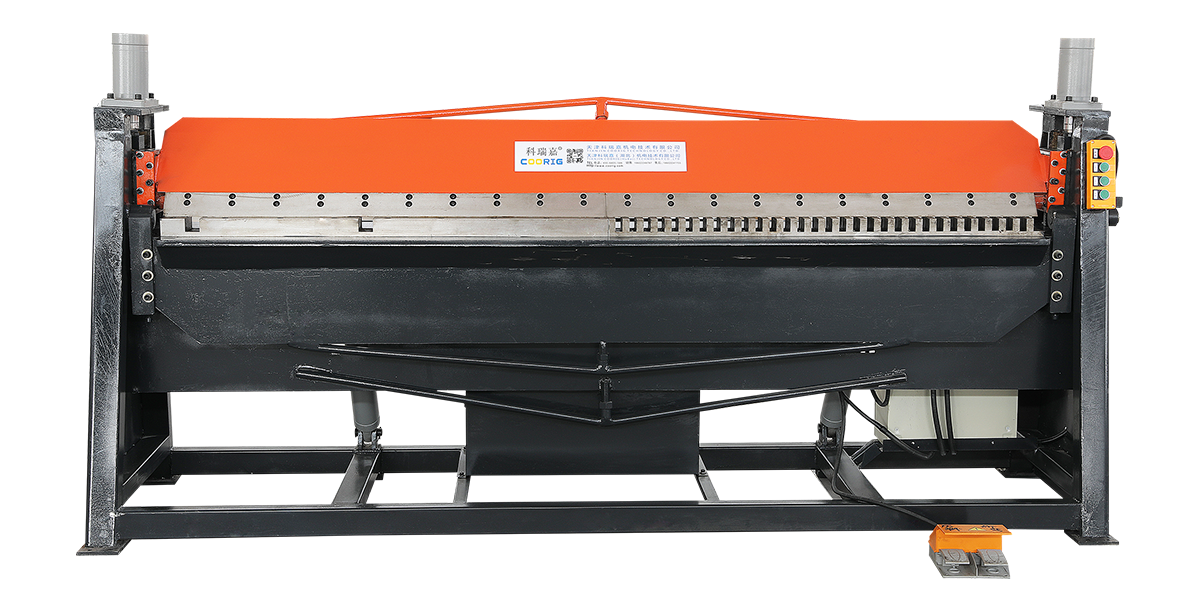
We are a hydraulic duct folding machine manufacturer, and this is the model we build for shops that form duct edges, returns and folded joints from stainless steel and heavier-gauge sheet.
The working principle is straightforward. A hydraulic clamp holds the blank along its full length while the bent beam turns to an angle the PLC holds to a set number. The fold lands where it was planned rather than where an operator's eye judged it, and the same setting repeats on the next part.
The frame is a steel plate welded structure, not a bolted assembly. That matters with stainless, which work-hardens as it bends and pushes back against the beam; any flex in the frame shows up as a curve along a long part. A welded frame and a heavy bed hold that load steady, which is why we recommend this machine for stainless steel duct folding for HVAC fabrication workshops rather than for light galvanized sheet alone.
Day to day, the operator lays a blank on the horizontal bed, enters the angle on the control panel and uses the foot pedal to clamp and fold, so both hands stay on the sheet for alignment. The orange clamping beam is easy to see against the work, and the panel sits at standing height.
Two working lengths are available, and they share the same hydraulic system and PLC angle control. The difference is how long a blank you can fold in one pass, which is set out further down.
Folding sits between blanking and assembly, so the machine usually stands near the shear or the plasma table, with clear floor at both ends of the bed for long sheets to overhang.
| Property | Value |
|---|---|
| Order code | 3031 (2000 mm bed) / 3032 (2500 mm bed) |
| Model | maximumProcessing length(mm) |
| Maximum processing length | 2000 mm / 2500 mm |
| Processing thickness | 0.5-2.0 mm |
| Rotation angle of the bent beam | 0-120° |
| Maximum upward movement of the upper beam | Total power(kW) |
| Total power | 4 kW / 5.5 kW |
| External dimensions (L × W × H) | 3000 × 750 × 1500 mm / 3500 × 810 × 1550 mm |
| Weight | 1800 kg / 2000 kg |
| Drive | Hydraulic clamping and folding |
| Control | PLC with folding-angle encoder |
On this hydraulic folding machine for HVAC ducts, the angle is a setting rather than a judgement call. The operator enters the target angle on the control panel, an encoder follows the bent beam as it turns, and the machine stops at the set position. The next part starts from the same number instead of from a mark scribed on a sample.
That changes how a batch runs. Once the angle for a duct side is set and checked against the first part, the rest of the run follows without the operator stopping to measure every fold. Rework drops, and a new operator can hold the same tolerance as an experienced one after a short briefing, which helps in shops where folding skill sits with one or two people.
Changing from one profile to another is a value change on the panel rather than a mechanical adjustment. Edge returns, hems and open folds all come off the same setting routine, and the angles for repeat jobs can be written down and dialled back in when that job returns.
The control also makes long parts more consistent. A long fold made by hand tends to open slightly at one end as the operator works along the sheet; with a hydraulic clamp holding the full length and the beam driven to a number, the angle stays even from one end to the other.
Both working lengths use the same control package, so choosing a bed length does not change how the machine is operated or how the angle is set.
A hydraulic folding machine for HVAC ducts sits between blanking and assembly, and that position decides what it is asked to fold.
In rectangular duct fabrication the machine forms the edge returns and folded joints that give a section its stiffness, and it turns out side panels in whatever length the job needs. Fittings work — transitions, offsets, plenum boxes, access openings — uses the same machine with short blanks and frequent angle changes, which is where the PLC setting pays for itself.
Stainless work is the case the machine was designed around: kitchen extract, industrial exhaust and similar ductwork where the material fights back against hand folding and a mallet can mark the surface. Galvanized HVAC work runs on the same settings, hems and returns included.
MEP prefabrication shops use it to build duct sections off site and deliver them ready to hang, and general sheet metal work — flashings, capping, folded panels — fits the same bed when the duct shop is quiet.
Because the machine is floor-standing and needs no pit, it can be placed where the material already flows instead of where a foundation happens to exist.
| Aspect | Hydraulic folding machine (W62YK) | Pneumatic TDF folder (AF-1.5) |
| Clamping and bending | Hydraulic clamp along the full bed, with the bent beam driven hydraulically | Pneumatic compression and folding on shop air |
| Angle control | PLC with folding-angle encoder, angle entered on the panel, 0-120° | Automatic folding cycle, with the fold angle set on the machine |
| Power requirement | 4 kW on the 2000 mm bed, 5.5 kW on the 2500 mm bed | No electrical supply, but 0.6-0.8 MPa of compressed air is needed |
| Working length | 2000 mm or 2500 mm | 1500 mm or 2050 mm |
| Sheet thickness | 0.5-2.0 mm | Light-gauge TDF flange work |
| Machine weight | 1800 kg (2000 mm bed) / 2000 kg (2500 mm bed) | 700 kg (1500 mm) / 850 kg (2050 mm) |
| Siting | Floor-standing on a level slab, no pit or foundation bolts | Floor-standing, no power drop required |
| Typical workload | Stainless steel duct folding for HVAC fabrication workshops, heavier galvanized sheet, long returns and hems | TDF flanges and light rectangular duct edges at moderate volume |
| Choose it when | The fold has to hold a set angle on 1.5-2.0 mm stainless and repeat across a whole batch | There is no spare power drop, the air line is already piped, and the work is light-gauge TDF |
Built to be re-sited. This hydraulic folding machine for HVAC ducts is floor-standing: no pit, no foundation bolts, nothing built into the building. The frame sits on a level concrete slab and is held by its own weight — so moving it when the shop is reorganised is a lifting job rather than a building job. If you lease the premises, expect to add a longer duct range later, or plan to run folding in a second bay, that freedom is worth knowing about before the order is placed.
Leave room around the bed. The footprint follows the bed length you choose. Beyond each end of the bed keep clear floor at least as long as the longest blank that will overhang there — a 2.5 m side panel needs that space on one side even on the short-bed machine. Leave a full standing position along the operator side with room to step back, and keep one long side clear for a pallet truck or forklift.
Plan the services, not just the footprint. The machine needs its electrical supply and a cable route to your panel that can be disconnected and re-made without cutting conduit out of a wall; if you rent the building, agree that route with the landlord at the start. Nothing else ties the machine to the building.
When the move happens. Lift from the frame only, with a forklift or crane rated well above the machine weight, and never from the bent beam, the control panel or the foot pedal. Secure the bent beam so it cannot swing, keep the pedal cable off the floor, and move the machine on timber bearers rather than dragging it across the slab.
First day in the new position. Re-level the frame front to back and side to side before anything else, because a frame standing on a slab that falls away folds a twist into every long part. Look over the hoses for chafe after the move, then test-fold a thin blank and a thick one and check both against a square before the shop goes back into production.
Keep the record with the machine. Store the manual and the written angle settings for your regular jobs with the machine, so a move or a shift change does not undo what you already worked out.
Tianjin Coorig Technology Co., Ltd. has been building sheet metal and MEP prefabrication equipment since 2004, with a team of around 200 people working from our own factory in Tianjin, China. In more than 20 years we have supplied buyers in over 35 countries — processing plants, mechanical installation contractors and agents — and we look after export, documentation and shipping as a one-stop service. A database of 3,000+ qualified suppliers, in-house quality control and our automated manufacturing systems keep build quality and delivery predictable. Reference work includes the Beijing Olympic Games, Egypt CBD, Guangzhou Baiyun Airport and BYD's European Center.
Stainless steel is the material it was designed around, and the same settings handle galvanized sheet and mild steel within the rated thickness. Thickness matters more than the label on the box: stainless is harder on the clamp than galvanized at the same gauge. If you plan to run aluminium, pre-coated sheet or an unusually hard grade, tell us before ordering and we will confirm the fold sequence for it.
The bent beam turns through 0-120°, which covers a closed hem, a right-angle return and an open profile past square. Springback is a property of the sheet, not the machine: set the angle, fold one test blank from the coil you are running, check it with a square or protractor, and adjust the setting once. Thicker sheet and harder grades return more, so keep a written setting per material and thickness and the batch will hold.
It is a floor-standing machine with no pit and no foundation bolts, so a level concrete slab is enough. Allow clear floor at both ends of the bed for long blanks to overhang, plus standing room in front. On power, give us your site voltage and phase before the order is confirmed so the electrical build matches what you actually have.
A pneumatic folder compresses and folds on shop air and needs no power supply, which suits light-gauge TDF work in a small shop. This machine uses hydraulics to clamp along the full bed and adds PLC angle control, which is what stainless and heavier sheet need to fold without creeping or bowing. As a hydraulic duct folding machine manufacturer we build both types, so once we know your material mix we will point you at the one that fits rather than the one that costs more.
Yes. It is floor-standing and not bolted down, so it can be lifted and re-sited. The two models weigh 1800 kg and 2000 kg, so use a forklift or crane rated well above that, lift from the frame and never from the bent beam or the foot pedal. After the move, re-level the frame and run a test fold against a square before production restarts.